

Are you worried about DNA in vaccines?
DNA in Vaccines
I’m not talking about future DNA vaccines, but rather about DNA contaminating the vaccines that we currently use.
Have you heard the stories that fragments of human DNA from fetal cells in the MMR vaccine could be linked to autism?
Or that human, pig, and other foreign DNA has been found in vaccines?
Vaccines still aren’t associated with autism, but highly fragmented (mostly destroyed) DNA can be found in some vaccines in very small amounts.
Why?
In 2010, porcine circovirus type 1 and 2 (PCV1 and PCV2) was detected in rotavirus vaccines. This porcine (pig) DNA was a contaminant of the residual medium in which the rotavirus vaccine was grown (and was detected because a new technique was developed). Fortunately, porcine circoviruses are not known to cause infection or disease in people.
In fact, “since both PCV species are highly prevalent in healthy pigs, human dietary and respiratory exposure to this virus is common through pork consumption. “
What about reports of human DNA fragments in Gardasil?

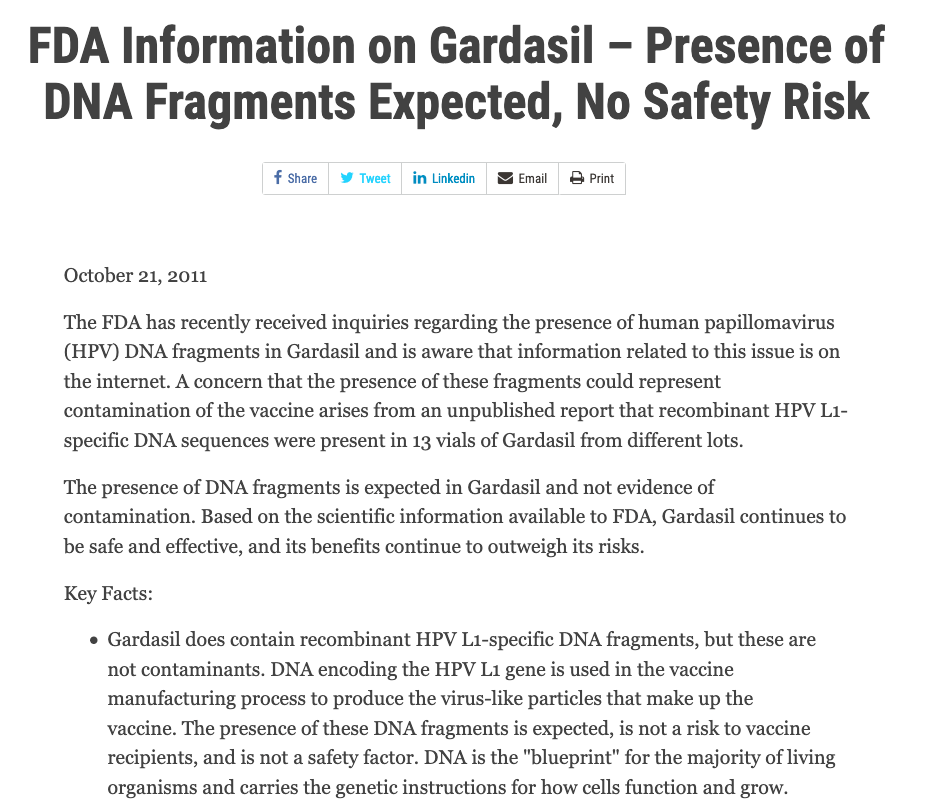
In 2011, the FDA reported that it had “recently received inquiries regarding the presence of human papillomavirus (HPV) DNA fragments in Gardasil and is aware that information related to this issue is on the internet.” They concluded that “the presence of DNA fragments is expected in Gardasil and not evidence of contamination,” and that:
- residual recombinant HPV L1-specific DNA fragments are present in Gardasil because “the HPV L1 gene is used in the vaccine manufacturing process to produce the virus-like particles that make up the vaccine”
- there are no full-length infectious HPV genomes
- this is not a contaminant and is not a safety hazard
Lastly, even when small amounts of fragmented DNA is leftover in a vaccine, it can’t cause harm because “DNA from the vaccine is not able to incorporate itself into cellular DNA.”
More on DNA in Vaccines
- Which Vaccines Contain Aborted Baby Parts?
- Are Vaccines Contaminated with Retroviruses?
- Vaccine Ingredients – DNA
- FDA – Detection of DNA from PCV1 in Rotarix
- WHO – Finding of DNA fragments of porcine circoviruses in rotavirus vaccines
- FDA – FDA Information on Gardasil – Presence of DNA Fragments Expected, No Safety Risk
- CDC – Adventitious Viral Genomes in Vaccines but Not in Vaccinees
- Oh, no! There’s DNA in my Gardasil! Or is there?
- “Aborted fetal tissue” and vaccines: Combining pseudoscience and religion to demonize vaccines
- Religious fundamentalists try to prove fetal DNA in vaccines causes autism and fail